Blog Design

_________________________________________________________
Showing posts with label Rocky. Show all posts

Monday, September 16, 2013

More Mealybug Drama!

So the little buggers are still around.  I have been meticulously spraying the plants with the Bayer Advanced Natria Insect, Disease & Mite Control. It gets rid of the bugs on contact and for a good 5 days afterwards, but they would surely find their way back.  I realized they must be hiding in the media itself.  I ordered online some Bayer 3-in-1 Insect Disease and Mite Control Concentrate.  This is a systemic poison with the main active ingredient being Imidacloprid (sold under the brand name of Merit), which has a very high success rate.  This insecticide is successful not only because of its chemical composition, but also due to the form in which it is administered.  It is fed to the plant during watering and in a few weeks, it makes the plant itself toxic so when the pests feed on the plant, they ingest the poison and die.  If this is what it takes to keep my orchids mealybug free, then so be it!

In the meantime, I took out each plant out of its pot and got rid of all of the media in the pots.  I  then carefully washed all the roots and sprayed each plant and roots with Bayer Advanced Natria Insect, Disease & Mite Control while out of the pot and left it to soak a good 10-15 minutes.  I then washed the pots thoroughly and let them sit in diluted bleach while the plants were being treated with the insecticide.  Once I was ready to repot, I prepared fresh new media, sprayed the insides of each ceramic and plastic pot with insecticide just in case any bugs were missed the first time and carefully repotted each orchid.  I also took the opportunity to sterilize the humidity trays and wipe the wooden coffee table well, even under its lip.  I didn't want to take any more chances with these resourceful and very tenacious little pests.

As I was treating the plants, I noticed Marilyn has grown a new root and leaf.  Audrey 2's roots are in much better shape and I also gave her a slight trim of a few dead roots.  Rocky is still hanging in there and appears to be doing much better.  The problem with Rocky is that he has so many nooks and crannies for the bugs to hide so he got an extra dose and time of pesticide goodness.  Vino had some great new growth, but lost 2 other leaves to the mealybugs .  I took extra time with him to ensure I got all the bugs.  Kalista was the worse off.  The bugs had established themselves in her delicate leaves and had infiltrated the media as well.  It was not pretty at all!

And lastly, Snow White's roots, unfortunately, had not only succumbed to the bugs, but also had dozens of black spots all over her roots.  Some type of fungus had attacked the weakened Phalaenopsis.  Since I didn't want the unidentified fungus to spread to my other plants, I painfully decided to toss it before it was too late.

I would say that the mealybugs won the last 2 rounds, but I came back with a killer upper cut and stunned them this time.  Let's see what happens in the next round?

Wednesday, September 11, 2013

I detest Mealy Bugs So Much!

At the beginning of August, I received Rocky in the mail.  Since then, I thought I had beaten the cursed mealybugs, but no, they just managed to stay low long enough to invade most of my other Paphs.  Yesterday, when I went to water Kalista, I found a few bugs in her creases.  I cannot find enough words to convey not only the surprise to find these unwelcome little pests, but the anger at having to start all over again trying to eradicate them.  I then examined all the plants and found that they had spread to all but one of my Paphs.  Thankfully, the Phals remained unaffected.

I treated all my plants with the homemade alcohol, soapy water mix.  It appears to have zapped the bugs that had congregated on the foliage.  I made sure to saturate the tops and undersides of each leaf.  I do feel that at this point, I need to call in the big guns.  Tomorrow, I am going to Home Depot and buying a systemic insecticide.  I am not taking any more chances.  These little guys are relentless.

I know that success in getting rid of them altogether hinges on consistency in administering multiple applications.  All I can do is hope that my orchids won't be too stressed and start declining in health during the treatment period.

After my visit to Home Depot, I found they did not have any of the Bayer 3 in 1 I had been looking for, but instead they had Bayer Advanced Natria Insect, Disease & Mite Control.  Apparently, the 3 in 1 is not sold in New York.  Although the Natria is not a systemic insecticide like the 3 in 1, it contains Sulphur and Pyrethrins, which should take care of things quite nicely.  The plants need to be treated every 7-10 days in a well ventilated area and away from any water sources.  I will admit that the sprayer that comes with the product is terrible.  It did not deliver a fine mist, but sloppily drenched the plants and everything around it.  I had to pour the product into my previous mister and then resume spraying all the plants over and under the foliage.

The insecticide certainly did zap the mealy bugs on contact, but it also has a really strong smell.  It does not dissipate right away, but instead tends to linger and if you get too close to it, it stings your eyes.  It is really important to provide good ventilation when using this product.  Even if you spray it outside, once you bring the plants indoors, they will still be rather smelly.

Friday, August 23, 2013

Orchid Updates

This post is just to report back on how all my plants are doing.  Of course, some are doing better than others, and some plants just seem overall hardier than others.  Right now, my problem child is Rocky.  After attempting to remove an old yellowing leaf, an incoming fan right in the center of the plant, simply tore right off.  This was Rocky last week before his trim:

Judging by appearances, everything looks fine here

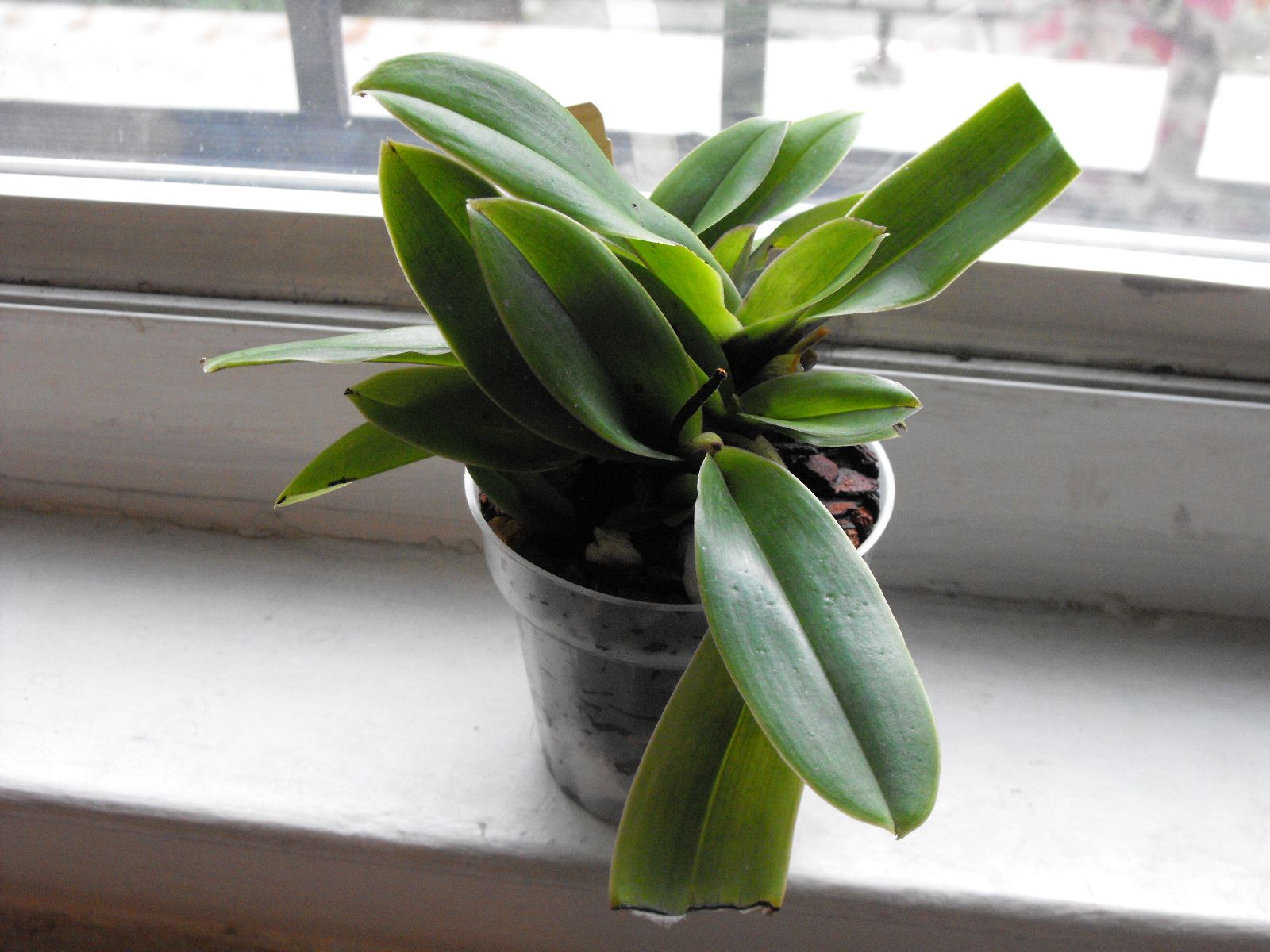
His foliage appeared full and green, but once I started to inspect the center of the plant to detach that left lower leaf, I discovered the center of the plant was black with rot.  To be honest, I was not entirely surprised.  After all, he was not in good shape when he was initially shipped to me.  I am trying my best to save him and he appears to be trying to grow, but those roots are still in horrible shape.  They are not any worse than when I received the plant so in a way, I do consider there has been some progress, but no new roots are growing at this time.  So, after my attempt to clean him up yesterday, this is what his foliage looks like now:


Upon closer inspection:


The important thing is that now air will get in between those leaves and heal much faster since the plant will remain drier.  Gathering from everything I had read, Paphiopedilum Spicerianum is a good grower.  It may be compact, but it has a rep for being easy to grow and quite prolific.

With all my Paphs, particularly the ones in distress, I have been feeding lightly, watering generously every couple of days since my conditions are quite dry, adding dolomite to the mix, and I have been using liquid kelp once a month to stimulate root growth.

My second most needy plant is my newest, Kalista.  She arrived quite bruised from being shipped.  She was also pretty dessicated and the leaves were mangled all together.  She also seems a bit discolored as if she had been exposed to way too much light.  Here is Kalista after almost a week of arriving in her new home:


She still needs a little more time, but she is recovering nicely.

In the opposite end of the spectrum, my success story has been my Paphiopedilum Oberhausen's Diamant, Marilyn.  She was fine until the middle of July or so when we had a bad heat wave and our family went away on vacation.  This, and the fact that I did not have a dedicated fan for the orchids, spelled heatstroke.  Out of all my orchids, she was the one that got it the worse.  Her foliage began drooping.  At first, I thought it was some type of fungal thing so I treated her with fungicide, which ended up burning her roots.  So, instead of helping, I ended up making maters worse.  She began to recuperate from the root abuse slowly, but was making steady progress.

Then, about 2 weeks ago, one of her leaves began yellowing and she began displaying numerous brown spots on the yellow leaf.  Again, my inexperienced instincts screamed out fungus or some type of rot, but a more experienced grower, recommended adding dolomite to the media for my Calcicolous Paphs.  The dolomite worked.  She is now doing much better.  You be the judge:

Before


After

And here is my collection; everyone doing much better!


Wednesday, August 7, 2013

And Here's Rocky!!!

Recently, I ordered a species Paph named Paphiopedilum Sanderianum from a vendor based out of California, near San Francisco.  I was so very excited.  After all, the plant was advertised as being BS (Blooming Size), which means by next season it should be ready to bloom, and he described it as being physically 'nice' and very easy to grow.  I gave the grower my credit card number, address, and waited for my beautiful plant to arrive.  The picture he had on his website to show the plant was similar to this one:


What a beauty, huh? Yeah, that bloom certainly is! Even the plant is supposed to be quite striking; so healthy and vibrant:


 However, what I got was this:


The plant actually looks much better now that I removed several leaves with some areas of mystery very dark brown stuff that I wasn't sure if it was some type of fungus, rot, or severe sunburn or scale.  There were dozens of little holes in various sizes clearly showing some parasite or insects had made a meal of this particular plant.  I immediately dipped it in Physan 20, but this time, I used it at a much more diluted ratio, and left the plant sitting in a bucket for a good half hour or so.  I also cut away everything (leaves and roots included) that looked rotted or suspect.

The roots were in terrible shape.  Most of the roots near the base of the crown were completely rotted and black  There were more unsheathed wiry centers rather than viable roots.  I repotted the struggling plant in a 3" clear pot in an Orchiata based mix.  I took the precaution of treating the media itself with Physan 20 as well.  I didn't want to take any chances with this plant.  It was in such rough shape and I didn't want it introducing something that would wipe out the rest of my plants.

Normally, I would've sent the plant right back, but since the vendor is based in California, frankly, I am not sure I will be able to get my money back.  He seemed to think this plant was acceptable to sell.  How do you reason with that? To be quite honest, I was really upset, but decided to make the best of it, and simply pruned, treated the plant with the fungicide disinfectant, and repotted it.

I decided to name it Rocky because not only is it off to a rocky start, but if it does bounce back, the plant is definitely a fighter:


Only time will tell what will be Rocky's fate, but jeez, I feel totally cheated on this deal!


________________________________________________


Update

A few days later, I spotted the beginnings of some mealybugs setting up shop on my plant.  I immediately mixed a homemade alcohol and soap mixture and sprayed it all over the foliage.  The next morning, I also gave him a brief shower in the shower stall with our massaging shower head.  Who knows maybe it need a massage? (j/k)  But, in all seriousness, I have continued watering this way just to ensure the little buggers get the message loud and clear that they are not to return.

I am hoping this will be the end of the tribulations with this plant.